
6130 N La Cholla Blvd, Suite 111 Tucson, AZ 85741
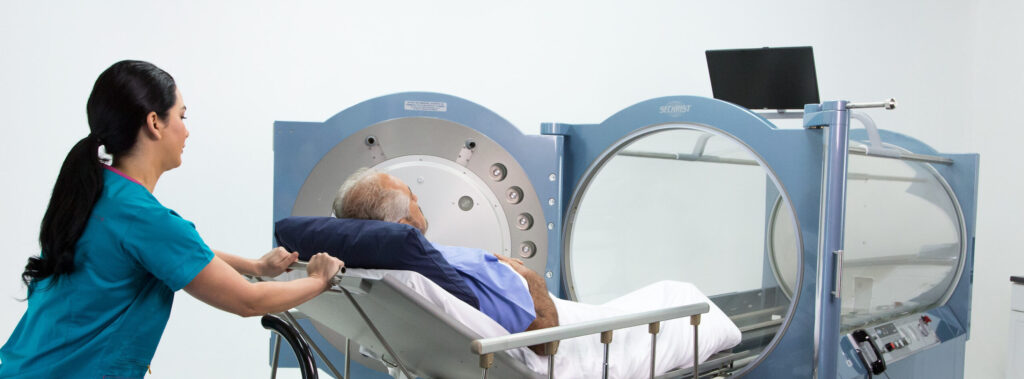
Hyperbaric Oxygen Therapy

Hyperbaric Oxygen Therapy (HBOT) is a medical treatment that enhances the body’s natural healing process by delivering pure oxygen in a pressurized chamber. By increasing oxygen levels in the blood, HBOT promotes faster healing of wounds, reduces inflammation, and improves overall wellness. Whether recovering from an injury, managing a chronic condition, or looking to boost health, HBOT could be the solution a patient needs.

Approved indications treated in an outpatient setting include:

  • Diabetic foot ulcers

  • Compromised skin grafts & flaps

  • Late effects of radiation

  • Osteomyelitis (refractory)

  • Crush injury

  • Thermal burns

  • Sudden sensorineural hearing loss

  • Necrotizing soft tissue infections

  • Central retinal artery occlusion

Hyperbaric Oxygen Therapy FAQ

What is hyperbaric oxygen therapy?

Hyperbaric Oxygen Therapy is a medical treatment in which a patient breathes 100% pure oxygen inside a pressurized chamber. The pressure inside the chamber is typically 1.5 to 3 times higher than normal atmospheric pressure. Under these conditions, your lungs can take in significantly more oxygen than they can at normal pressure. This oxygen is then dissolved into your blood plasma and carried throughout your body—even into areas with reduced or blocked blood flow. HBOT has been approved by the Undersea & Hyperbaric Medical Society (UHMS) and the Centers for Medicare & Medicaid Services (CMS) for specific conditions, including certain types of chronic, non-healing wounds.

You may qualify for Hyperbaric Oxygen Therapy (HBOT) if:

1. You Have a Wound or Condition Approved for HBOT

The Undersea & Hyperbaric Medical Society (UHMS) and Centers for Medicare & Medicaid Services (CMS) recognize HBOT for specific conditions, including:

  • Diabetic foot ulcers (Wagner grade 3 or higher)

  • Radiation tissue injury (osteoradionecrosis, soft tissue radionecrosis)

  • Chronic refractory osteomyelitis (persistent bone infection)

  • Compromised skin grafts or flaps

  • Acute traumatic ischemias (e.g., crush injuries)

  • Certain serious infections (gas gangrene, necrotizing soft tissue infection)

  • Carbon monoxide poisoning (with or without cyanide poisoning)

  • Air or gas embolism

  • Acute arterial insufficiency

  • Thermal burns (severe)

2. Your Wound Has Not Healed with Standard Care

Most insurance plans require that the wound:

  • Has been present for at least 30 days

  • Has not improved after 4–6 weeks of standard wound care (specialized dressings, infection control, offloading, etc.)

3. You Meet Safety Requirements

Before starting HBOT, your provider will:

  • Review your medical history (certain lung diseases, ear problems, uncontrolled seizures, or untreated fevers may require special precautions)

  • Order tests, such as chest X-rays or vascular studies, if needed

  • Confirm you are safe to tolerate increased pressure and 100% oxygen

4. You Complete a Wound Care Center Evaluation

At your first visit, the team will:

  • Assess your wound’s size, depth, and tissue health

  • Evaluate circulation to the area

  • Document treatments you’ve tried so far

  • Determine if HBOT will improve healing and prevent complications

Here’s a step-by-step overview of what typically happens during a Hyperbaric Oxygen Therapy (HBOT) treatment:

1. Preparation Before Treatment

  • Check-in & health review – Staff will confirm your medical history, vital signs, and any changes since your last visit.

  • Clothing change – You’ll change into 100% cotton garments provided by the facility. This prevents static electricity and is part of fire safety protocols.

  • Remove prohibited items – Watches, phones, hearing aids, jewelry, lotions, makeup, hair products, and any flammable items are not allowed inside the chamber.

  • Wound dressing – Your wound will be cleaned and dressed appropriately before treatment.

2. Entering the Monoplace Chamber

  • The monoplace chamber is a clear acrylic cylinder that allows you to see outside and communicate with your care team through an intercom.

  • You’ll lie down on a comfortable bed that slides into the chamber.

  • Many patients find the chamber comfortable and non-claustrophobic because it’s transparent and well-lit.

3. Pressurization (“Descent”)

  • The chamber is sealed and pressure is slowly increased to the prescribed level (usually 1.5–3 atmospheres absolute [ATA]).

  • You may feel pressure in your ears—similar to flying in an airplane or diving underwater.

  • Staff will guide you on how to equalize the pressure (swallowing, yawning, or the Valsalva maneuver).

4. Breathing 100% Oxygen

  • In a monoplace chamber, the entire space is filled with pure oxygen, so you simply breathe normally—no mask or hood is required.

  • The treatment usually lasts 90 minutes, during which you can relax, listen to music, or even nap.

  • Staff monitor you the entire time via video and intercom.

5. Depressurization (“Ascent”)

  • Toward the end, the chamber pressure is slowly reduced to normal atmospheric pressure.

  • You may again feel popping in your ears as pressure equalizes.

6. After Treatment

  • The table slides out, and you can get up right away.

  • Vital signs may be rechecked.

  • Most people feel completely fine, though some may feel mildly tired or lightheaded for a short time.

  • You can return to normal activities immediately unless instructed otherwise.

Ready to learn more? Call or message us today to find the treatment that’s right for you!

Get In Touch